
AREDS Supplements for Macular Degeneration: What the Science Actually Says
A comprehensive, evidence-based breakdown of AREDS and AREDS2 — who should take them, what's in them, and what 25+ years of research tells us.


Evidence-based reviews
AMD nutrition
What Is Age-Related Macular Degeneration?
Age-related macular degeneration (AMD) is one of the leading causes of irreversible central vision loss in people over 50 in the developed world. It affects the macula — the small, central part of the retina responsible for sharp, detailed vision — and progresses through distinct stages: early, intermediate, and late (advanced) AMD.
Late AMD has two forms: geographic atrophy (the "dry" advanced form, where retinal cells gradually die off) and neovascular AMD (the "wet" form, where abnormal blood vessels grow under the retina and cause rapid vision loss). While wet AMD has effective treatments with anti-VEGF injections, geographic atrophy has historically had very limited options — making prevention of progression absolutely critical.
This is precisely where the AREDS supplements come in.
AREDS1: The Landmark Trial (2001)
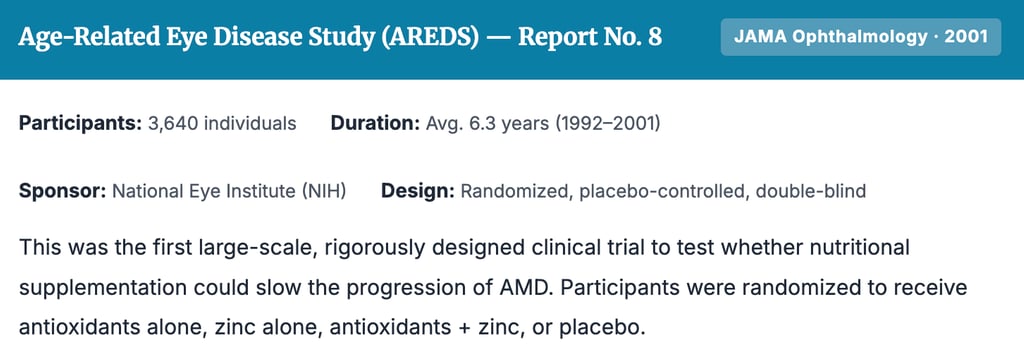
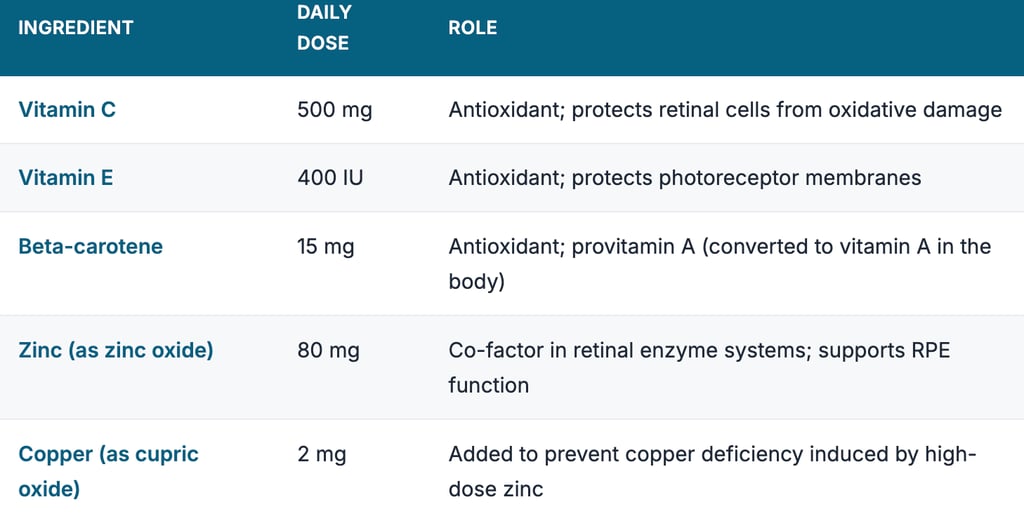
AREDS1: formula
The Key Results


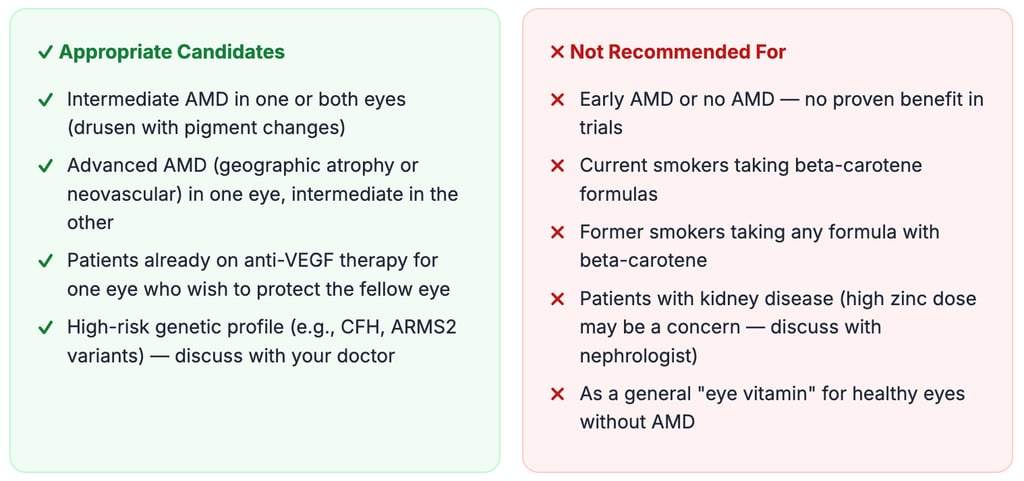
These results were striking. For the first time, a randomized trial confirmed that a non-prescription supplement could meaningfully alter the natural course of AMD. However — and this is critical — the benefit was only demonstrated in people with intermediate AMD, or advanced AMD in one eye. Patients with early AMD, or no AMD, did not show a statistically significant benefit in this study.


AREDS2: The Refined Formula (2013)
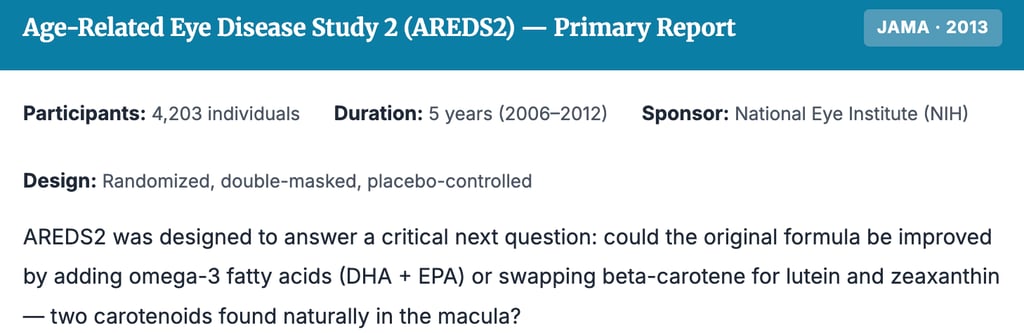
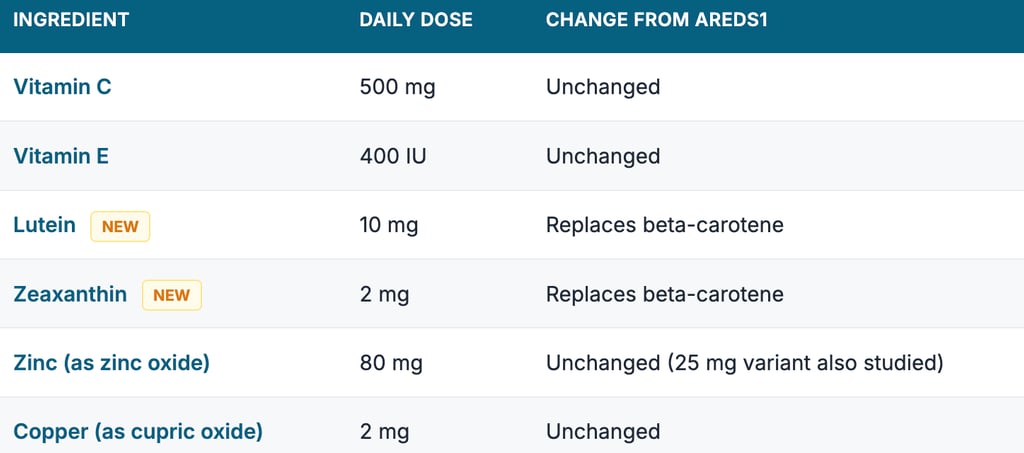
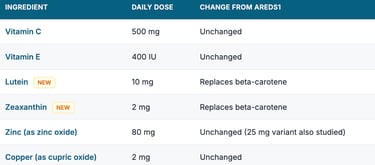
AREDS 2: formula
What AREDS 2 found
The primary analysis showed that adding omega-3 fatty acids (DHA + EPA) to the AREDS formula did not significantly reduce AMD progression. Adding lutein/zeaxanthin also did not show a statistically significant benefit in the overall trial population.
However, a key secondary finding changed clinical practice: in participants who had very low dietary intake of lutein and zeaxanthin, the addition of these carotenoids did appear to reduce progression risk. More importantly, the secondary analysis comparing lutein/zeaxanthin versus beta-carotene in the same formulation showed that lutein/zeaxanthin performed at least as well as beta-carotene — with a significantly better safety profile.
AREDS2 identified a significant safety concern — former smokers assigned to beta-carotene had nearly double the rate of lung cancer compared to those assigned to lutein/zeaxanthin (2.0% vs 0.9%, p=0.04). This finding is consistent with prior trials (CARET, ATBC) and has led to a clear clinical guideline: beta-carotene-containing AREDS formulas should not be used in current or former smokers.
The Clinical Consensus
The AREDS2 formula (with lutein/zeaxanthin instead of beta-carotene) is the current standard of care recommendation by the American Academy of Ophthalmology (AAO) for patients with intermediate AMD or late AMD in one eye. No other supplement has been shown in rigorous RCTs to match its effect on AMD progression.
Best AREDS 2 Supplements on Amazon
How I Evaluated These Products
Each supplement was evaluated against one standard: does it match the exact formula used in the AREDS and AREDS2 clinical trials? That means Vitamin C 500 mg, Vitamin E 400 IU, Lutein 10 mg, Zeaxanthin 2 mg, Zinc 80 mg, and Copper 2 mg — the only combination with Level 1A evidence for reducing AMD progression. Products were also assessed for safety, value, and practical usability.


#1 Top Pick
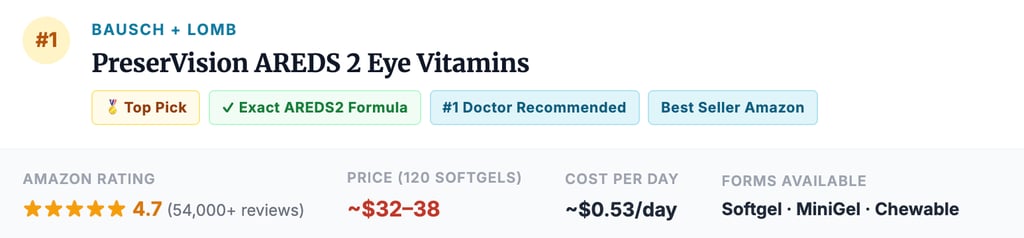

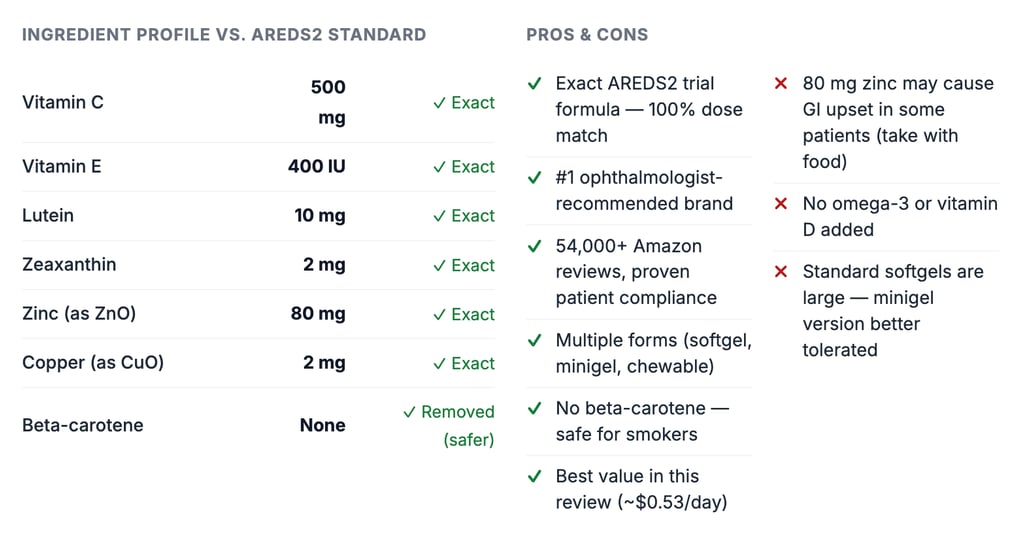
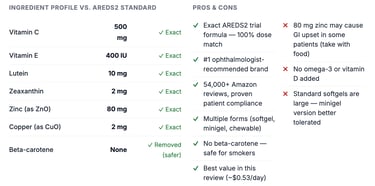
PreserVision AREDS 2 is the product I recommend to my own patients with intermediate AMD. It is the only formulation in this review that replicates the exact doses used in the landmark NEI trials — the same doses that produced the 25% risk reduction we rely on in clinical practice. With the highest review count on Amazon and competitive pricing, there is no clinically meaningful reason to choose another product. This is my first-line recommendation.
Doctor's Rating: ★★★★★

#2 The Runner Up
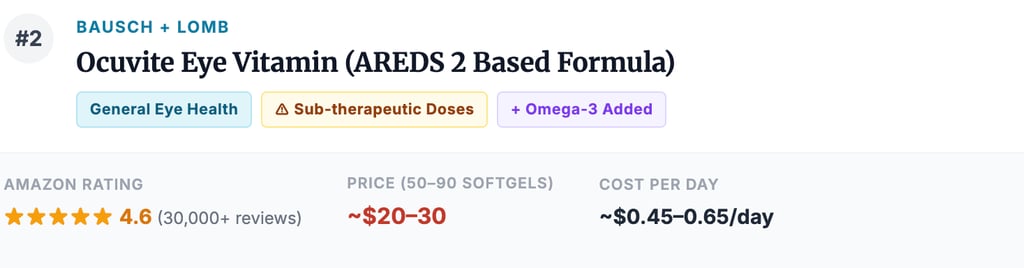
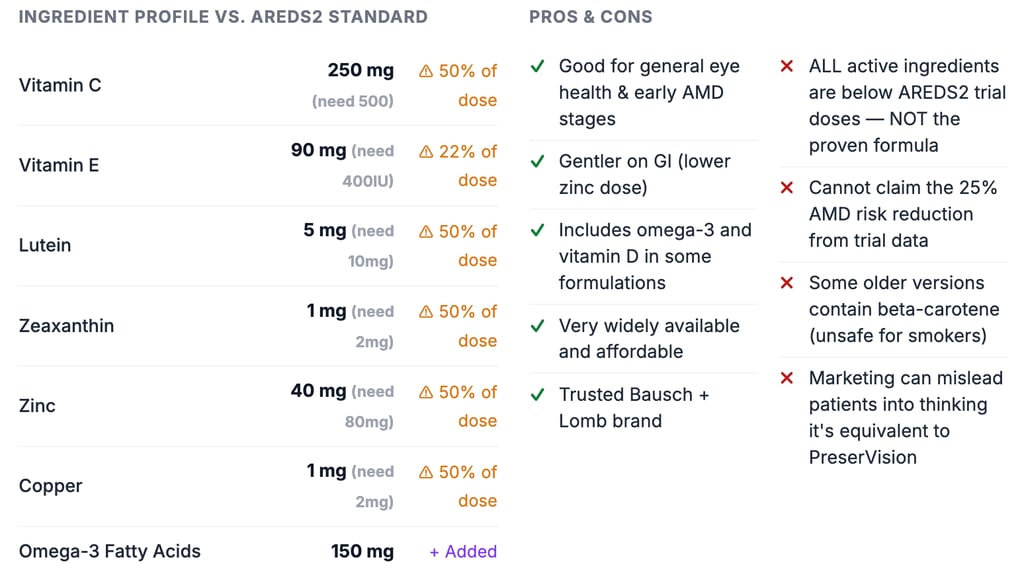
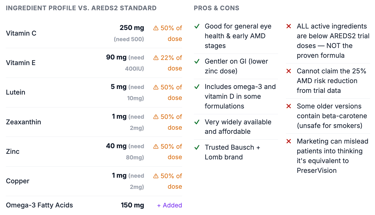
Ocuvite is appropriate for patients seeking general eye nutritional support — people with early AMD or healthy eyes. However, I must be clear: Ocuvite's AREDS-based formulas use sub-therapeutic doses across all six key ingredients. No clinical trial has validated these reduced doses for AMD progression. If you have intermediate AMD, Ocuvite is not an adequate substitute for the full AREDS2 formula. This is a common and consequential confusion I see in clinic.
Doctor's Rating: ★★★

#3 The Premium Option
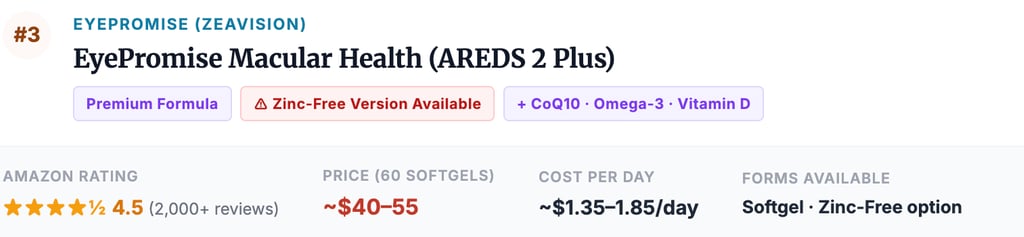
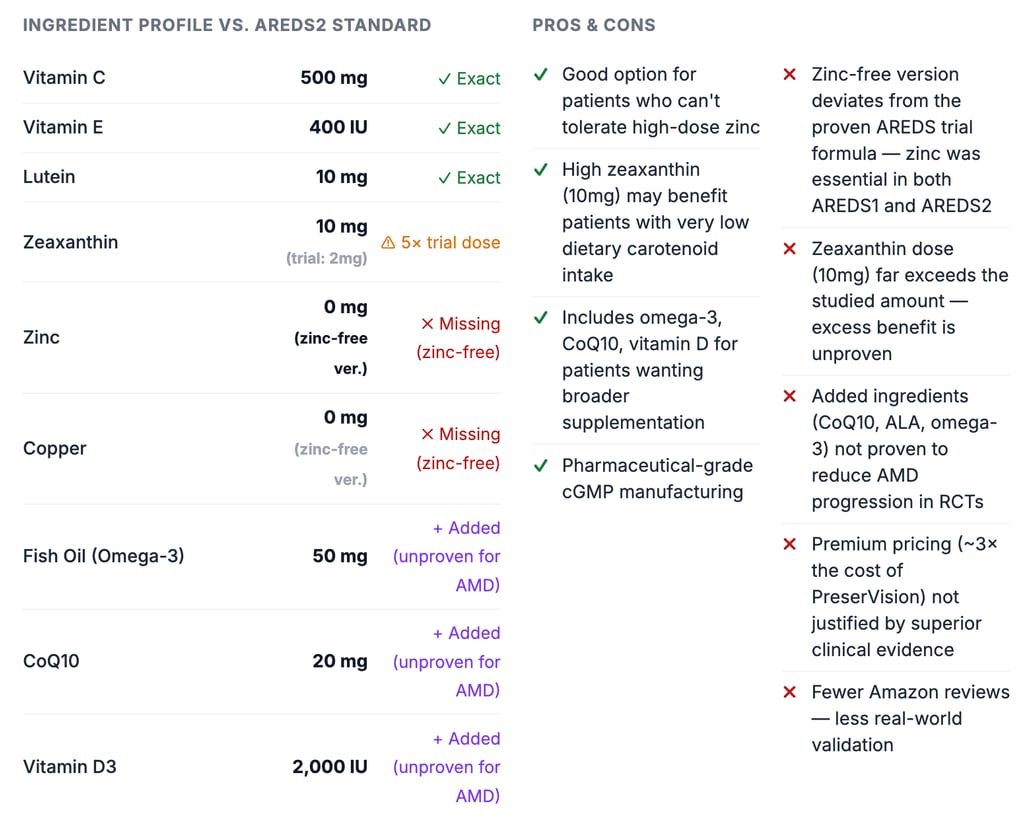
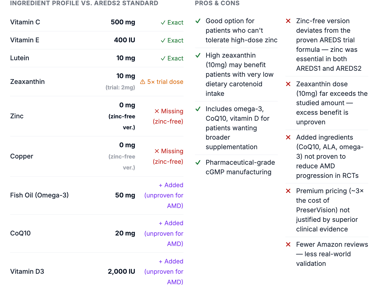
EyePromise's zinc-free formulation concerns me clinically. Zinc was a critical component in both AREDS1 (80 mg) and AREDS2, and removing it creates a product without the full proven formula. For patients with genuine zinc intolerance, this may be a necessary compromise — but it should be discussed with your ophthalmologist. The added ingredients (CoQ10, alpha-lipoic acid, omega-3) are interesting but are not supported by Level 1 evidence for AMD progression. The premium price is not justified by the clinical evidence available today.
Doctor's Rating: ★★★
🩺 My Bottom Line
Of the three products reviewed, PreserVision AREDS 2 is the clear clinical choice for patients with intermediate AMD. It is the only supplement here that delivers all six ingredients at the exact doses validated in the NIH's randomized controlled trials — the same doses responsible for a 25% reduction in progression to advanced AMD. It is also the most affordable per-day option of the three, and carries the most real-world patient validation on Amazon by a wide margin.
Ocuvite is appropriate for patients seeking general eye nutritional support — particularly those with early AMD or no AMD diagnosis — but it should not be used as a substitute for PreserVision in patients with intermediate AMD. The sub-therapeutic doses across all six ingredients mean it cannot claim the same evidence-based benefit.
EyePromise Macular Health may suit a narrow group of patients — particularly those with documented zinc intolerance — but this should only be done under ophthalmologist guidance, with the understanding that removing zinc from the formula deviates from the proven AREDS2 combination. The premium price is not supported by superior evidence.
As always, no supplement replaces regular dilated eye exams and monitoring by your ophthalmologist. These vitamins slow progression — they do not reverse AMD or replace anti-VEGF treatment for neovascular AMD.
Prices and ratings are approximate, based on Amazon listings as of April 2026, and may vary by seller, size, and subscription options. This review is entirely independent — Dr. Eye Reviews has no financial relationship with Bausch + Lomb, EyePromise, or any supplement manufacturer. All clinical statements are based on published peer-reviewed literature. This article does not constitute individual medical advice.